In my career as a trainer, I have been fortunate to coach dozens of lifters to the platform. As a gym owner, I ran a powerlifting team and coached my lifters to numerous PR’s and National Qualifying totals.
Powerlifting is not a complex activity to coach. We are focused on one domain of training - getting stronger - but the act of getting stronger is rooted in smart training, proper periodization, appropriate rest, and peaking for the day of the meet.
I remember one gym member coming to me with a program she had from an outside coach. When I looked it over, I was shocked.
Her squat day included four different squats, each with multiple sets. Her bench day was the same, and so was the deadlift day. There wasn’t any reason for that type of volume, and there were over 20 sets of different squats.
Needless to say, her progress was crawling, and once she started working with the in-house powerlifting program I built, she began to see progress on her lifts. We cut the volume dramatically, switched to an upper/lower split, and her workouts decreased from over two hours to 75-90 minutes max, depending on how long she rested between heavy sets.
You see coaches trying to reinvent the wheel, but when it comes to strength training, the wheel has rolled the same for decades. Research has clarified what we know and exposed more coaches to proper training, but the wheel stays mainly the same.
The majority of the lifters I have coached are unequipped powerlifters, meaning they do not wear supportive gear like squat suits and bench shirts. I have coached (and still do coach) some equipped lifters, but raw lifting is the most common form of competitive powerlifting, and the lessons I will share are from the perspective of a raw lifter.
Gym PR’s are great, but the platform matters more.
It is easy to hit a gym PR when you are not under the stress and the rules of competition.
Performing a touch-and-go bench press for a new PR is not the same as hitting the same number under competition conditions. This isn’t to say your gym PR doesn’t matter, but if you are a competitor, our job is to translate that strength to the platform, not just show it in the gym.
A solid gym PR is motivating and shows that you are on the right track, but if you cannot transfer that to competition day, there is more work to do on your technique, stress/mindset management on meet day, or setting up with a proper peaking cycle.
Strength is not built solely on SBD (squat, bench, deadlift). Building muscle matters.
Lifting big weights requires a supportive structure that can handle those weights. Looking at genetic outliers like Lamar Gant, who pulled 661 pounds while weighing 132, and assuming you don’t need mass to move mass is a false conclusion. Most of you reading this are not going to fall into the outlier category; therefore, you need to add mass and muscle.
A proper powerlifting program will ensure you are adding the muscle needed.
A term was invented for that several years ago - Powerbuilding - but it’s a redundant term meant to sell programs. If you look at the strongest lifters across all classes, they are muscular.
Big backs
Muscular arms
Well-defined legs
Strong shoulders
Not only does adding muscle help your lifts increase, but it will also help protect you from injury.
This concept can be expanded upon when you look at the squat.
Most people will assume the squat is enough for strong quads, and they are not entirely wrong, but in order to ensure proper strength progression while minimizing injury risk, we need to look at the entire quad.
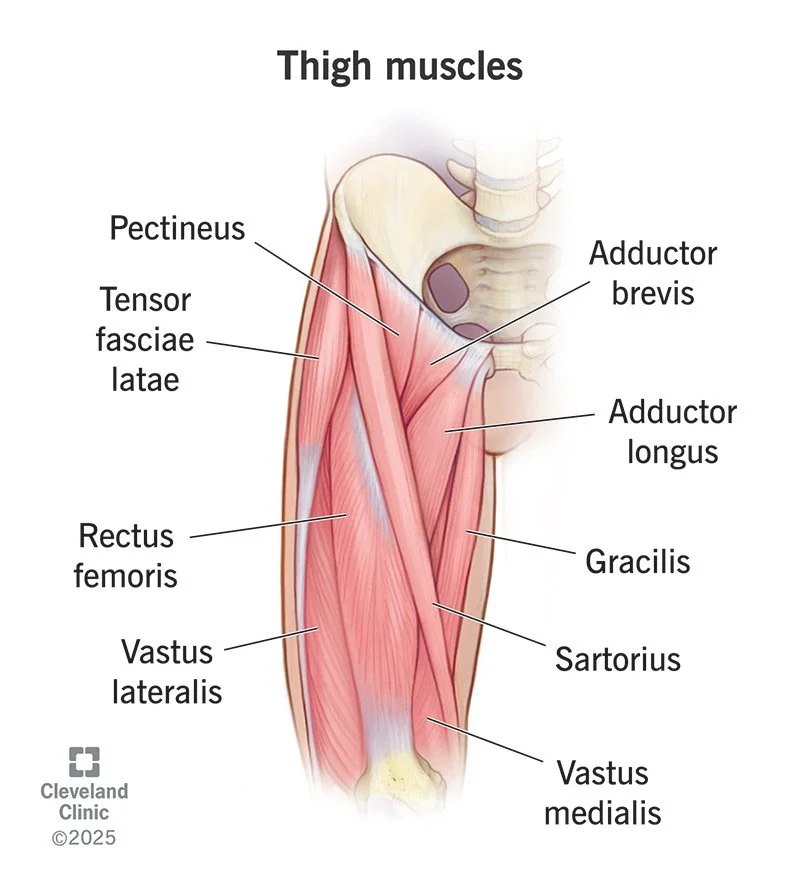
I am not going to give you a full anatomy lesson as to what each individual muscle does for your lifting, but I will go over the important ones.
Vastus lateralis
This is your outer quad sweep. It’s the muscle that gives your legs the appearance of width. If you look at any big squatter, this muscle will be large. Squatting focuses on this muscle. This muscle only crosses the knee joint, so it will respond to heavy squats, hack squats, pendulum squats, quad-focused leg presses, and leg extensions.
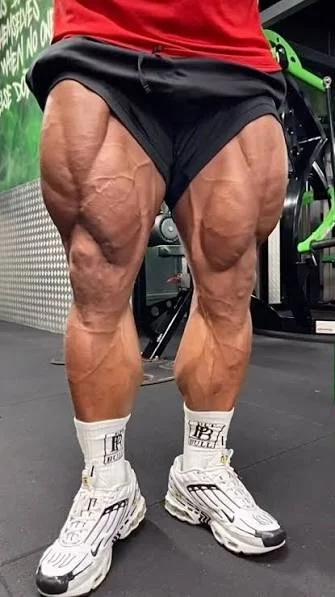
The above image shows an IFBB bodybuilder’s leg development with the wide outer quad sweep.
Rectus femoris
This is the muscle that looks like an upside-down triangle in the middle of the thigh. It is the only quad muscle that crosses both the knee and hip joints; therefore, squats and leg presses do not stimulate it well enough for any sort of meaningful growth. This muscle is best built with leg extensions (with a reclined seat), sissy squats, reverse Nordic Curls, and even hanging leg raises.
Vastus medalis
The VMO, or more commonly known as the teardrop. This is the teardrop-shaped muscle on the inner quad close to the knee, and it’s one of the most underdeveloped quad muscles in powerlifters. This muscle attaches to your kneecap via the quadriceps tendon, and its main purposes are to straighten the knee joint during locomotion or squatting, and to pull the kneecap inward to counterbalance the outward pull of the vastus laterals which will help prevent knee pain and kneecap tracking issues.
Exercises that work this muscle the best include cyclist squats (feet close together with elevated heels using more than the standard lifting shoes), Terminal knee extensions, reverse sled drags, and leg extensions with toes pointed up and squeezing at the top of each rep.
When you take all of this into consideration, a sample squat workout could look like this:
Warm-up: include mobility and TKE’s
A1: Squat 80% 3x3, 85% 2x2, 90% x1
B1: Cyclist squats 72.5% 3x8
C1: Leg Extensions with reclined seat 2x15
D1: Seated Leg Curls 3x12
E1: Standing Calf Raises 3x15
You can do more posterior chain work on the second lower body day, which is deadlift-focused.
There is no reason to worry about a weight class if you are within sight of winning.
This is a pet peeve of mine.
Your main focus as a lifter should be getting stronger, adding muscle, learning how to compete, and being consistent with your training and eating. Adding complexities like weight cuts and water loading is not necessary for the majority of lifters.
If your strength has improved enough that your numbers put you within reach of winning, then you can entertain the idea of cutting weight.
There are legitimate reasons to cut weight that have nothing to do with competing, but to cut weight because you want to is adding unneeded stress to your body.
A proper peaking cycle shouldn’t leave you feeling beat up.
If I had a dollar for every lifter I have seen say “this peak is leaving me beat up,” I would be able to get dinner at Morton’s and have some left over for a tip.
There is an element of overreaching when it comes to peaking properly, but the intensity of the plan should be offset by lowering the volume on the supporting lifts. If you are training properly, you should be able to shift right into a peaking program without having to ramp up in weights and waste time.
I write about my specific peaking philosophies in my powerlifting e-book “Behemoth Strong”; a program that has been put to the test numerous times with my gym members, clients, and program testers.
In that book, you will find a full program for off-season and peaking, and it includes my meet day sheet to help you plan your meet properly. It takes into account if you are having an off day or if you are feeling extra spicy on the platform.
Show up to compete, even if you know you won’t win.
Powerlifting is an individual sport. If you are lucky enough to train with a team, they will help you achieve your individual goals, but your training and your performance on the platform are up to you.
I have been at meets where people miss their attempts because they are too busy socializing or taking pictures with other lifters. It has to be embarrassing to time out on your attempt because you are chatting with a Facebook friend you never met.
There is nothing wrong with meeting people and enjoying yourself, but remember why you are there.
You trained for this.
You dialed in your nutrition.
You paid the entry fee.
You traveled to the meet.
Even if you are only competing because it’s a personal victory and not a platform victory, it doesn’t matter.
Keep track of when you have to warm up, pay attention to the order of the lifters, know whom you are following so you are ready for your name to be called, and focus your efforts on doing the best you can.
If you have a coach with you, it is their job to ensure you are in the position you need to be in with the above, but if your coach has to hunt to find you, there is a problem with your focus or their focus.
There is only one winner for each class and one best lifter for each gender, but everyone is there to compete. Whether that competition is placing as high as you can or simply setting new PR’s, the same rules apply.
Treat yourself like an athlete, mentally and physically. Look at lifting as a long-term plan and not a short-term thing, and you will have many years of enjoyment and competition to look forward to.
I am accepting clients for nutrition and training services. With over 25 years of experience as a trainer, I can help you achieve your goals.
Join my mailing list for list-only updates and emails.
